In our world today, the ‘anxious artist’ stands alone, confronting multiple destinies, as his own self appears as a broken machine, spinning restlessly like a swirl in a hopeless attempt topiece together its fragmented parts.
The Field of Dreams is an exploration of formations of ‘steel’ in the public space from the perspective of the relationship between the self, the object and the other. It can be viewed as an interactive space with the fragile reality in which humanity lives.
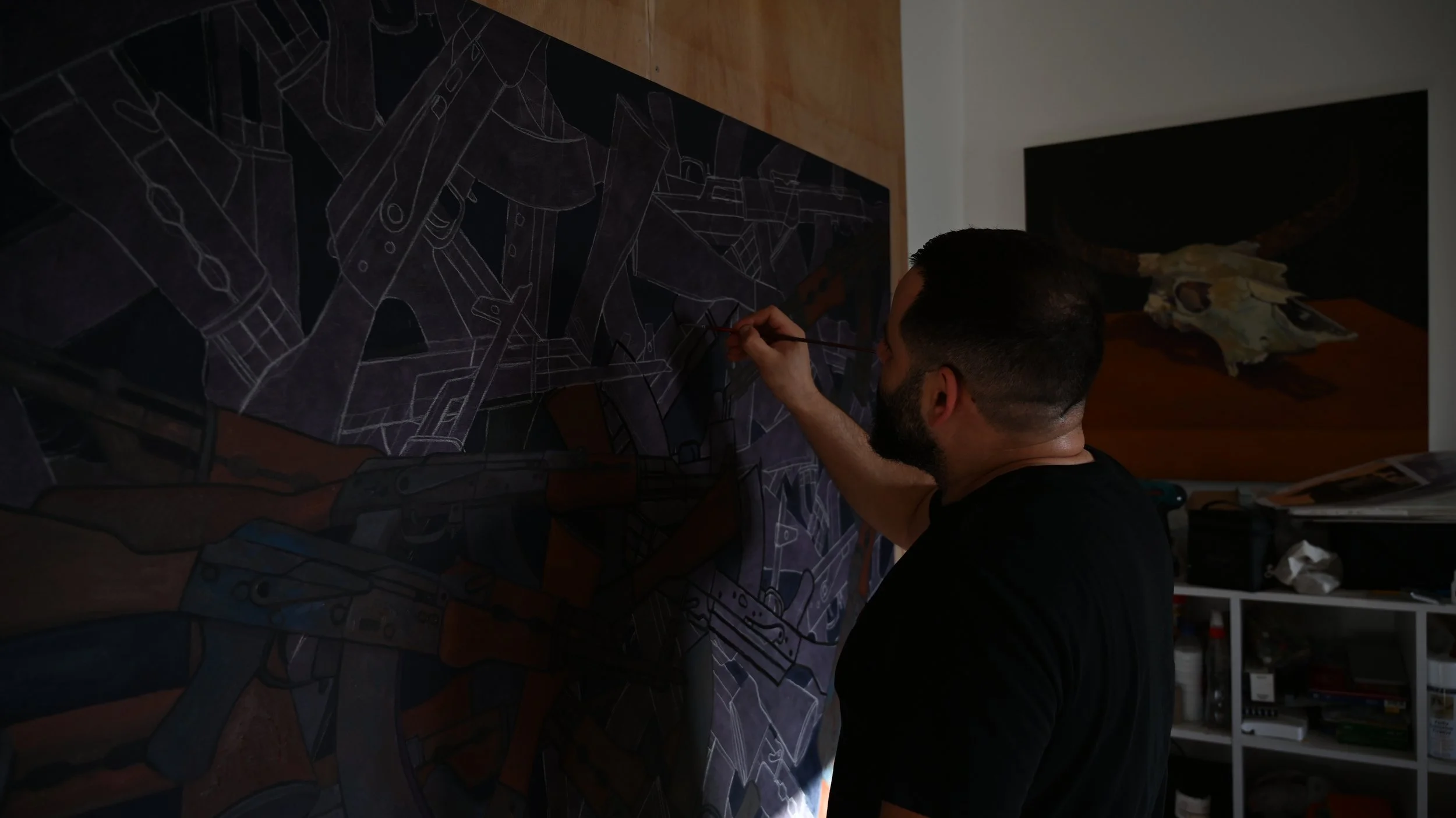
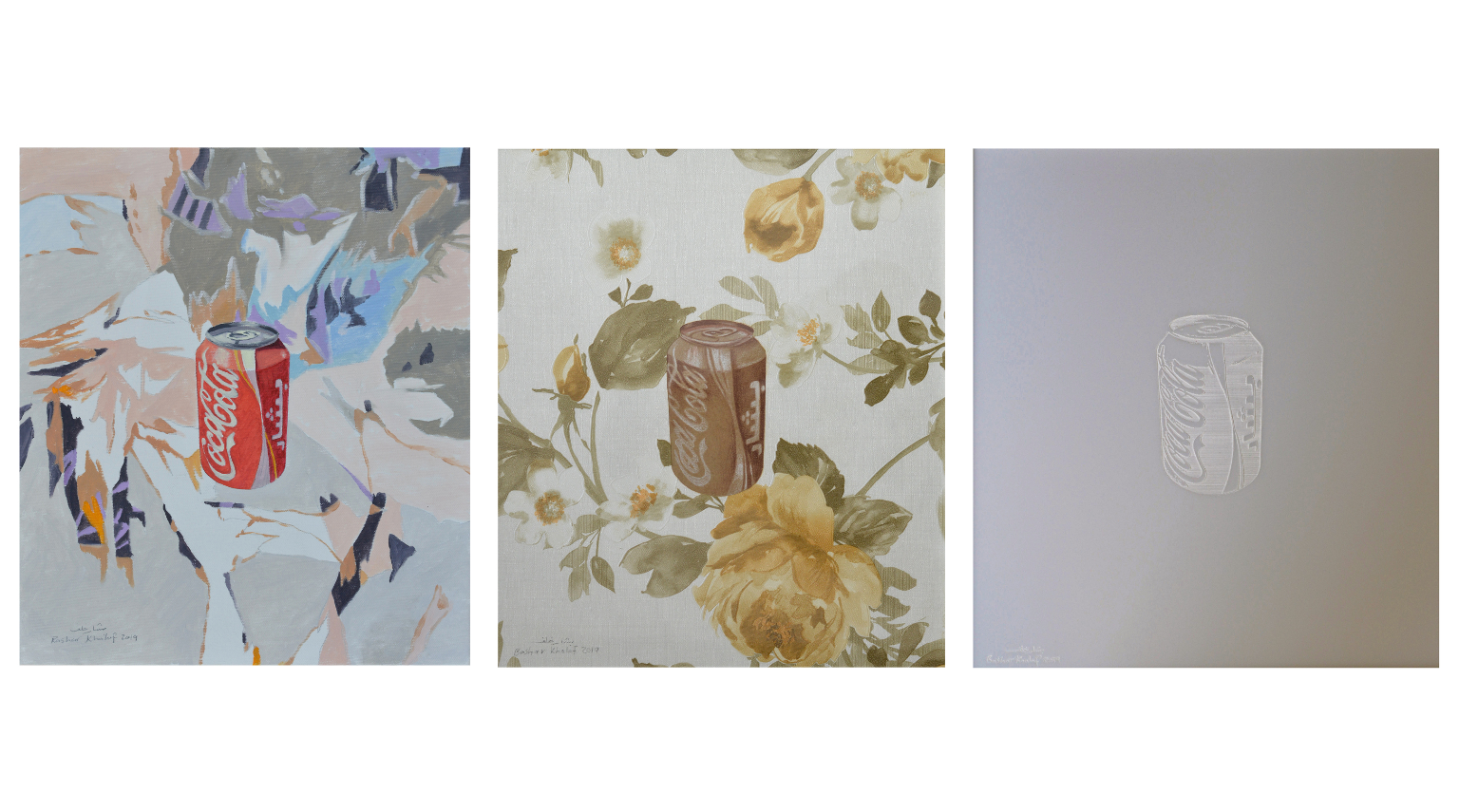
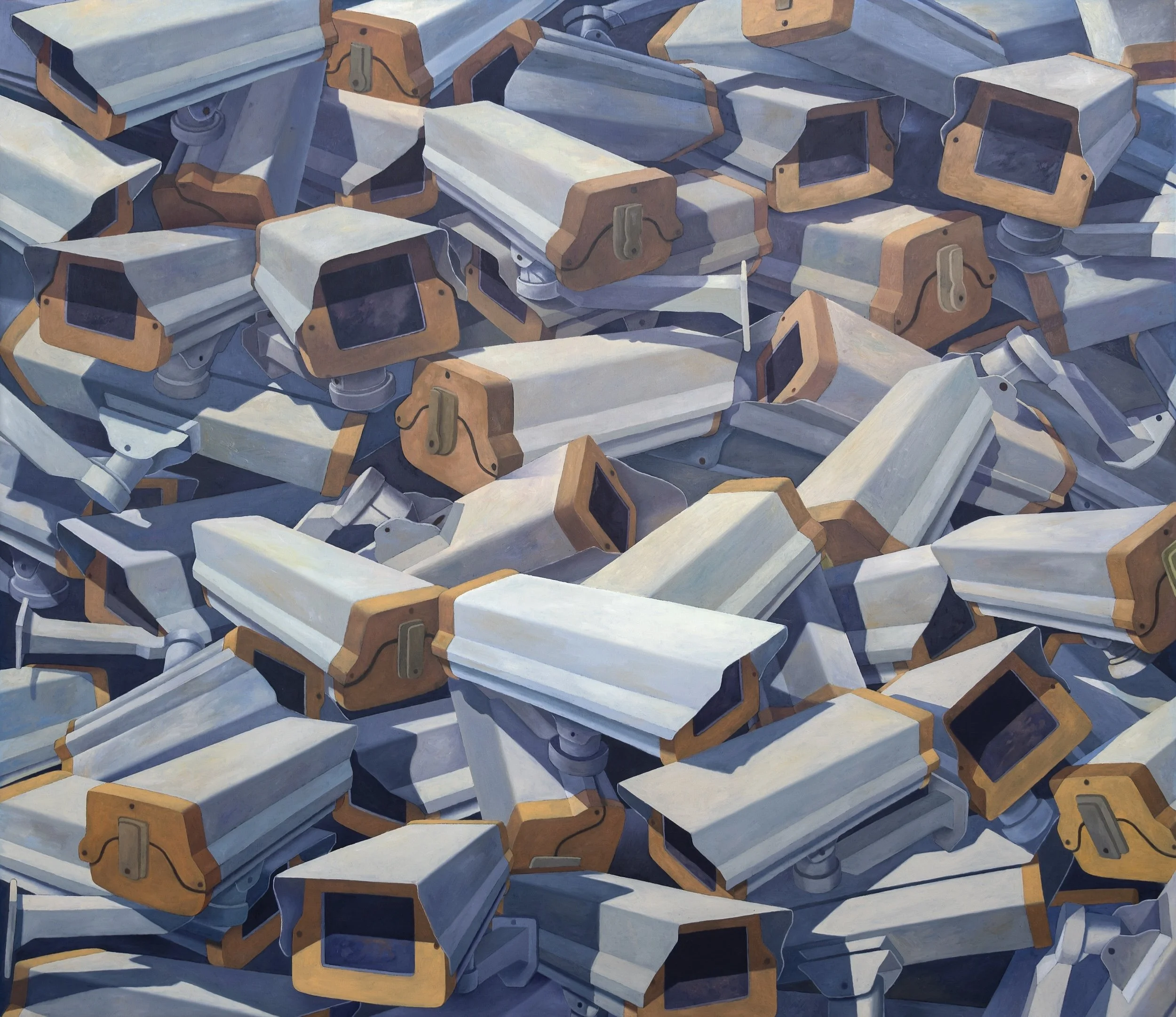
Artist Bashar Khalaf creates an ambiguous dialogue with accumulated ‘steel’ by employing several dry and liquid media. He uses oil colours in two series of artworks: Junk Garden and Protective Shield; charcoal on paper in the series Alhisbeh Fire; and plastic acrylic colours that hint at the relationship of all these elements with place through the series WeRamallah.
In a complex language, Bashar Khalaf confronts us with the dilemma of the present, not with the goal of transcending it, but of comprehending and understanding it.
In fact, this state of contradiction possesses an exceptional ability to fix our gaze upon the era in which we live, focusing on its most ambiguous aspects. This is the essence of the thinking of the ‘contemporary’ artist who, as Giorgio Agamben describes, ‘firmly holds his gaze on his own time so as to perceive not its light, but rather its darkness’ (Agamben, 2009, p. 44).
The matter may appear confusing when we ask: What drives Bashar Khalaf to fix his gaze on the sites of fracture in the present?
And what is their relationship to other temporalities: the past and the future?
The appeal of the artworks in The Field of Dreams lies not only in the diversity of their approaches, but arises primarily from the varied gestures they contain and the ways in which these gestures affect one another. The exhibition’s central problem thus appears complex, unfolding across three interwoven levels. The first dismantles time within a‘memory archive’, classifying it into past and future while affirming the centrality of the present. The second is grounded in Bashar Khalaf’s own self: how he views society and objects, and the local questions that branch out from them. The third is connected to global repercussions and their effects on humanity’s future.
Under objective conditions, these levels converge at sites of ‘fracture’. At their core, they draw their philosophical depth from a troubled preoccupation experienced by Bashar Khalaf in a world of mirrors opening onto themselves.
This preoccupation produces no answers; instead, it generates endless questions and drives a breathless pursuit of an understanding of the complex relationships between the individual and the self, society and objects: how might these relationships be perceived, re-presented and communicated to others in exhibitions? This circular ambiguity constitutes a frightening departure from the present despite living within it; in other words, a multiplicity of external and internal perspectives.
Accordingly, the operation of darkness surrounding The Field of Dreams is manifested in its capacity to document the world as it is today in both its private and public dimensions, with its frail structure and collapsing formations. The symbols of doubt presented by Bashar Khalaf centre on what is shared and what remains contested. The flow of darkness spread by the paintings thus points to the paralysis of the present and its dissolution into two simultaneous axes - the past and the future.
This is the essence of the vision that Bashar Khalaf seeks to embody through his works in The Field of Dreams.
The Archaic Appearance in Junk Garden: The Machine
The Field of Dreams, or dreams as minefields, is nothing more than the dysfunctional and non-operative dreams of ‘junk’. They remind us of their dynamic state, the unavoidable multiplicity of their possible outcomes and their subordination to the modern, brutal and dominant structures that govern forms of life. The conceptual paradox lies in granting the energy of dreams to bygone ‘steel’ structures - bulldozers, vehicles and surveillance cameras - giving them an immense power to reinvent themselves and generate their own symbols for understanding the world.
We witness the shattered ‘machine’ losing itself in the chaos of its struggle with destiny, much like a war in which power crumbles before the energy of scrap metal to reveal and portray the true face of the world. The machine is confronted with its own existence, given a tragic form and drawn into a profound engagement with the cycle of time, as though repositioning itself differently in relation to the world and others. This proximity to ruin - made visible in
Bashar Khalaf’s atemporal images of shattered bulldozers, exhausted vehicles and other forms - accompanies the old in its sorrowful decline, allowing it to see itself anew and return to us once more, but in a distorted, fragile and painful form.
What, then, makes isolated junk carry all these meanings?
Its inwardly submerged structure enables it to say so much. The machine, with all the vitality and authority it once possessed, acquires a particular artistic appeal through its cessation and the chaotic entanglement of its parts. This offers a profound expression of our divisions and distortions. Despite steel’s rigid formal structure, scenes of disintegration are the most prominent: objects appear to be collapsing, their sides filled with gaps and cracks that reverberate within us.
Bashar Khalaf treats his internal forms according to this mode of ordered chaos. The paintings in the Junk Garden series are built through a density that occupies the entire surface of the canvas, in an attempt to describe, on the broadest possible scale, the extent of the fragmentation caused by ‘the machine’. The immense power acquired by machines has made the world more fragmented than it should be, until it appears crowded with shards: human and material, chains, mechanical arms, wheels and nerves. Here, art composes the fragments in a form that is fragile yet dense. This abandonment of the old form expresses, in its substance, society and its dysfunctional relationships in the processes of producing and reproducing life.