
Who Gets to Tell Our Stories?
On Arab Literature, Translation, and a Generation Learning to Write Itself
by Hanaa Khadraoui
Who gets to tell a country's story? What might seem like a simple question is deceptively so because literature is never just about the person holding the pen. It’s also about who gets published, what gets translated, what gets marketed to foreign readers, and ultimately who gets to decide what a culture looks like on a larger scale once its stories leave home. For the Arab and wider Middle East, this question carries a particular heaviness.
The region is home to centuries of literary traditions that have preserved not only political and historical events but the private details of everyday life: from family structures, humour, dialects, memories, traditions, beliefs, and the ordinary experiences that rarely make it into history books. Literature is, in many ways, an archive of the things history often misses.
Yet when an Arab or Middle Eastern story crosses a certain linguistic border, it is inevitably processed through another person's eyes. The truth is, translation is not the enemy of cultural preservation. In fact, it is one of literature's greatest tools for allowing stories to take flight.
But translation is never simply the exchange of vocabulary. A culturally specific expression might have no direct equivalent in English, a joke might depend entirely on dialect, and a historical reference might carry an emotional significance that requires no explanation to an Arab reader but several paragraphs of context for someone elsewhere in the world. The translator then must decide what to preserve, what to adapt and what to leave behind.
Lawrence Venuti's distinction between domestication and foreignization is useful here, so should a translated work be made comfortable and familiar to its new audience, or should the reader be allowed to experience some of the unfamiliarity of the original? Neither approach is entirely wrong but both can dramatically change the way a culture is perceived.
The problem becomes more complex when translation meets pre-existing ideas about what the Arab world is supposed to look like. Edward Said's Orientalism remains essential to understanding this. Said argued that Western representations of the "Orient" historically constructed the East as mysterious, exotic, irrational, timeless, or fundamentally different from the West.
The issue was not simply that individual writers used stereotypes but that representation itself operated within specific structures of power. The people being described were often not the people controlling the narrative.
This legacy can still be felt in literature and popular media forms when Arab characters are repeatedly reduced to familiar symbols: the veiled woman, the patriarch, the religious extremist, the oppressed victim, the dunes in the desert, a childhood spent in war-torn cities. Of course, these things can all exist within Arab lives, and writers should be free to explore them. The problem however, arises when that conceptualization becomes the vocabulary through which Arab lives are expected to be understood.
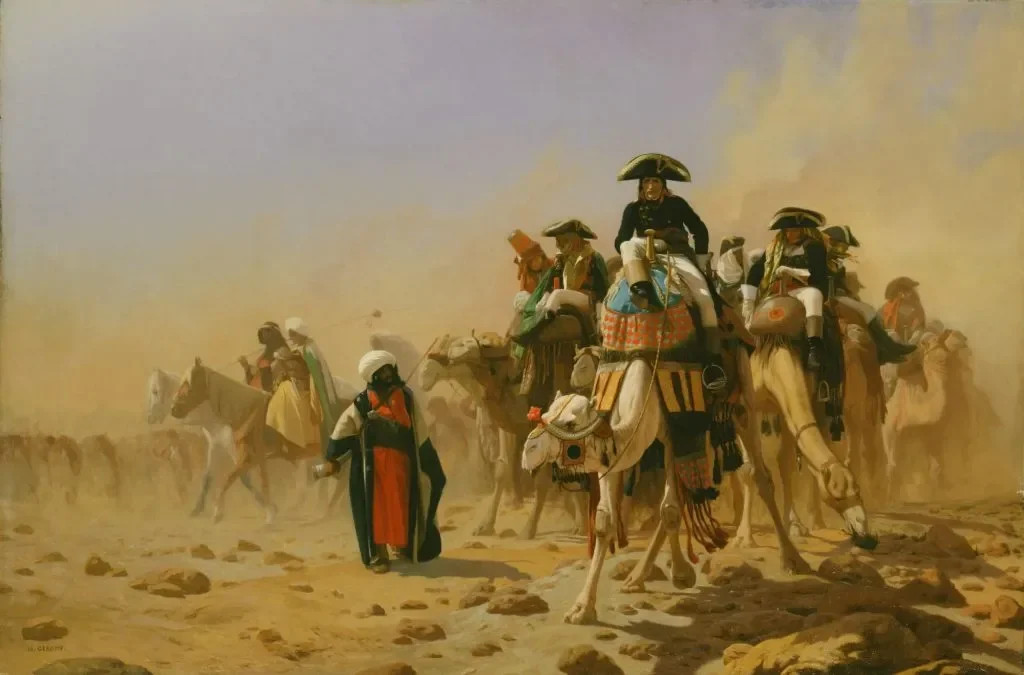
“Napoleon with His General Staff in Egypt,” 1863, Jean-Léon Gerome, Hermitage Museum
This is why the emergence of Arab writers who write directly in English is so fascinating; their work challenges the assumption that writing in English means adopting a Western worldview.
Egyptian novelist Ahdaf Soueif once explained "I never chose to write in English, I just found myself writing in it," adding that while her narrative could come to her in English, the dialogue in her head remained Arabic. Her novel The Map of Love consequently became an international literary success while remaining deeply concerned with Egypt, Egyptian identity, and the relationship between Egypt and the West. The significance is not simply that an Egyptian writer reached an English-speaking readership, it’s that she did so without giving up the cultural backdrop from which the story emerged.
Hisham Matar offers another version of this complicated relationship with language. Having been born in Libya and later displaced from his country, Matar has written extensively in English about Libya, exile, memory, and the experience of losing a homeland. He once reflected on the strange fact that he was "operating in a language my grandparents would have not understood."
There is something intensely revealing about that confession because it captures the experience of an entire generation of writers whose identities exist between languages. English can be the language of a publication without becoming the language of its memory. A writer can write in English while carrying Arabic inside every character, setting, and recollection.
Leila Aboulela, the Sudanese novelist, has expressed a similar tension. English became the language of her education and eventually her fiction novels, but her work continues to explore Sudanese, Arab and Muslim experiences without reducing it all to cookie-cutter exposition for Western readers. Laila Lalami has also confronted the uncomfortable expectations placed upon Arab writers who publish in English.
She once stated "I feel like I'm not considered Arab enough because I don't write in Arabic." Her observation exposes the impossible standard facing many bilingual and diasporic writers: either write in Arabic and have your work struggle to cross linguistic borders or write in English and face a multitude of questions concerning your authenticity. Arab writers can find themselves simultaneously too foreign for one audience and not Arab enough for another.
Maybe that’s why the most important development in contemporary Arab literature is not the choice between two languages but instead, the growing refusal to accept that language determines cultural ownership.
Iraqi writer Sinan Antoon, who writes in Arabic and works extensively between the two, has described language as "a reservoir of memory, tradition and heritage." This idea is worth holding onto because it reminds us that cultural identity does not disappear simply because the language on the page changes. A story written in English can still carry an Arab worldview and simultaneously still speak to a global audience. The two are not direct opposites.
For younger Arab writers in particular, this matters because representation is not just about seeing Arab faces in literature. It is about seeing Arab lives treated as worthy of literary space.

Sinan Antoon by Ibtisam Azem
Randa Jarrar has spoken about growing up surrounded by Arabic storytelling and poetry while reading English books in which she rarely saw people like herself. Her realization that she could write stories about Arab and Arab-American experiences was, in itself, an act of literary possibility. Once writers begin telling their own stories, they are no longer simply responding to the caricatures that have been created around them, instead they are creating their very own archive.
And perhaps that archive does not always have to always be dramatic. An Arab tale does not need a war, a revolution, a veil, a desert, or a political crisis to justify its existence on the pages. A writer should be able to write about a beloved family member, a toxic relationship, a neighbourhood disappearing beneath new buildings, a childhood summer night, or the strange experience of belonging to several places at once.
These otherwise ordinary details can become historical documents precisely because they preserve the very core of lives that the world often overlooks. And a generation writing about its ordinary experiences is, in its own quiet way, deciding what deserves to be remembered.
While Western authors enjoy the literary privilege of writing characters whose cultural background is treated as the neutral, universal default, allowing mundane elements like Christmas trees or Sunday church visits to simply exist without exposition or explanation, Arab authors often face a heavy double standard. They are frequently pressured either to overexplain every minute, every exoticized detail of Arab life, so that an external Western audience can digest it or to strip away their characters' distinct cultural identities altogether in favour of homogenized, Westernized tropes designed to be "relatable" to a general readership.
This expectation robs Arab literature of its autonomy, forcing writers to act either as reluctant cultural translators or as conformists, rather than allowing their characters the simple, unburdened dignity of existing on the page.
This pressure to satisfy foreign expectations often actualizes what literary theorist Gayatri Chakravorty Spivak critiques as the trap of the "native informant," which is where an author from a marginalized or postcolonial culture is implicitly or explicitly nudged to validate, explain or authenticate their homeland for a Western audience.
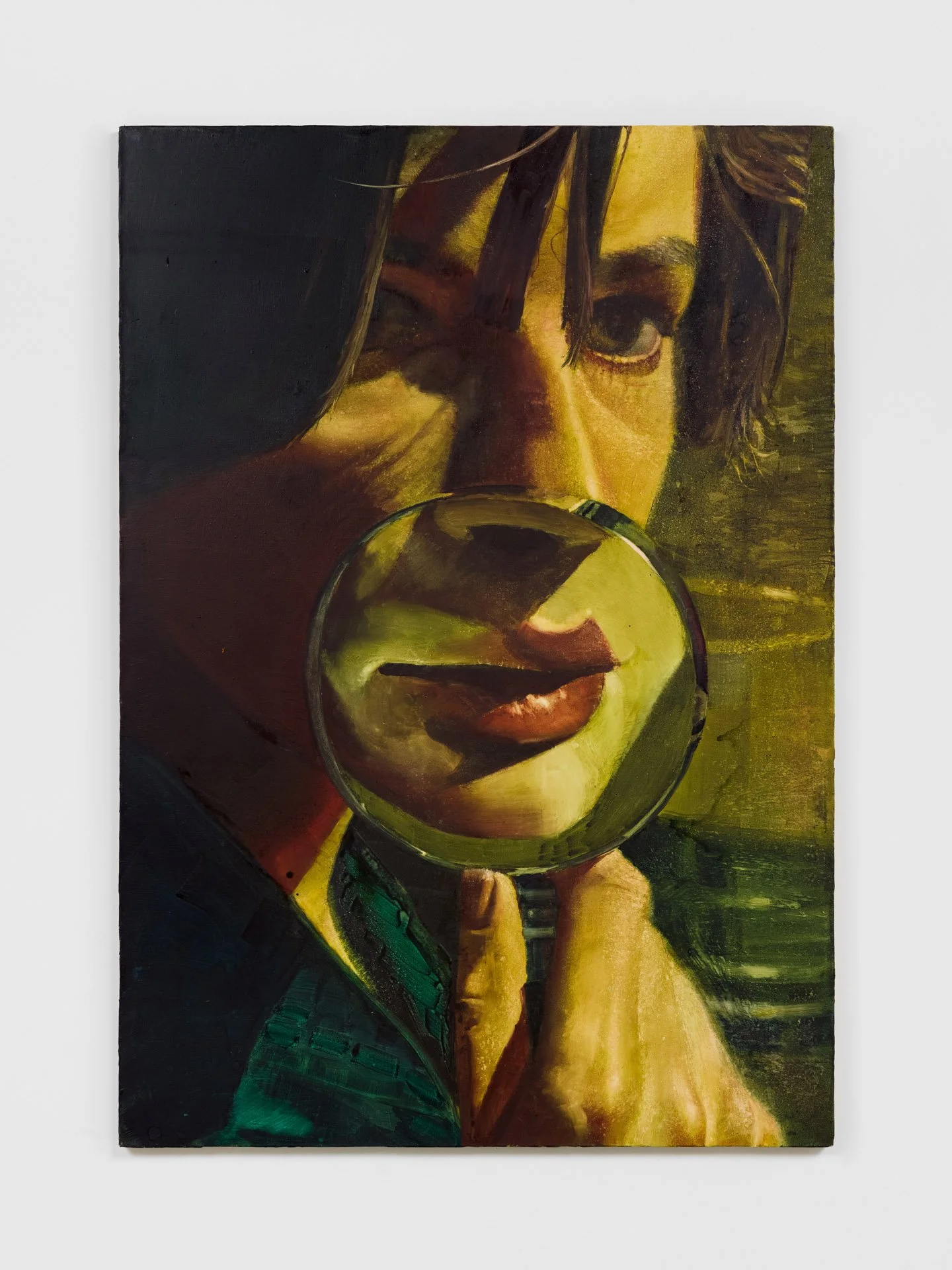
Doublespeak, Joseph Yaeger
Scholars like Hamid Dabashi have similarly explored how metropolitan publishing centers commodify literature from the Global South, rewarding texts that perform a digestible, marketable version of "authenticity."
When writers internalize these external gazes, they risk reducing their own complex societies to a self-conscious performance of exoticism, effectively curating their heritage as a spectacle just to secure a platform.
The future of Arab literature, then, should not be about creating a perfectly "authentic" Arab voice or rejecting foreign languages in favour of linguistic purity. I believe that culture is not static enough for that. The Arab world has always been multilingual and diverse, constantly changing and shaped by movement between places and languages.
The more important question is who gets to be the voice of that world. When young Arab writers choose to write directly in English, they are not necessarily translating themselves for the West. They are expanding the space in which Arab stories can exist, allowing their histories, humour, contradictions, and extraordinary lives to reach readers without first asking whether those readers will find them familiar enough or sufficiently exotic.
And that is what it means to write ourselves back into the story.
Not to reject translation, the English language, the Western world, or the complicated history of cultural exchange but to vehemently refuse the idea that our tales must arrive edited for someone else's expectations and tastes.
The language may change, the audience may change, and the medium may also change, but it does not become less valuable because it crosses the land.
After generations of being described, interpreted, and sometimes simplified by outsiders, maybe the most powerful literary act to be enacted by the next generation is to pick up the pen and decide for themselves what the world gets to see.