
In the bustling urban and rural landscapes of Morocco, the taxi system serves as the essential infrastructure of national mobility. This regulated monopoly, historically the dominant pillar of the transport sector, is divided into two distinct species: the Petit Taxi and the Grand Taxi.
Together, they navigate a complex landscape of territorial rights and social rituals, facilitating the movement of millions across a North African environment defined by vibrant street life and a unique history of shared transit.
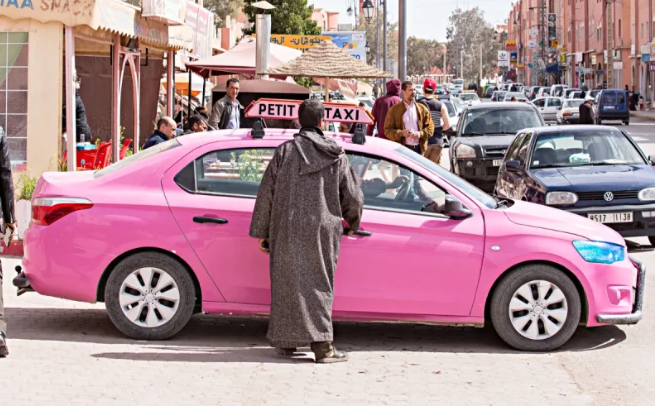
Source: bladi.net
The Petit Taxi
The Petit Taxi is the primary mode of point-to-point transport within city limits. These compact vehicles—typically Dacia Logans, Peugeot 207s, Fiat Unos, or Peugeot 205s— are strictly prohibited from traveling beyond the outskirts of their home city under penalty of license forfeiture. A quintessential detail of their material heritage is the simple open wooden box often affixed to the roof; these racks allow passengers to carry oversized luggage and goods through narrow city streets without the need for complex securing mechanisms. The legal mandate for fare calculation is the Compteur (taximeter). The base rate varies by city, typically ranging from 1.70 MAD to 7 MAD. While the system is highly regulated, a legal nighttime surcharge of 50% is applied to the meter. In major hubs like Casablanca, this premium window is strictly defined from 8:00 PM to 6:00 AM.
The Grand Taxi
The Grand Taxi serves as the workhorse for regional transit, connecting cities and remote villages. These vehicles operate from a designated place des grands taxis (taxi stand). Rather than a dispatch office, the station is managed by the “Mul-Taxi” — the chief broker or overseer of the square who orchestrates the flow of vehicles and passengers, often recording departures on a simple piece of card. The system relies on a departure protocol: a vehicle typically only departs once it has reached its full complement of six passengers. In the classic Mercedes-Benz era, this involves a specific seating arrangement where two passengers share the single front passenger chair next to the driver. Passengers navigate this system through two primary options: buying a “chair” and sharing with other passengers, or hiring the full vehicle and paying for all six seats.
Colour Coding the Taxi
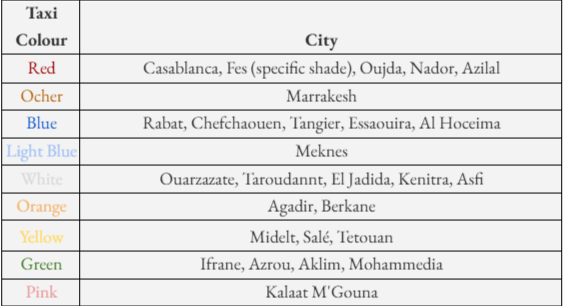
Morocco employs an official visual system for licensing and territorial identification. Body colour serves as a regional identifier, allowing authorities and passengers to determine a vehicle’s jurisdiction at a glance. Even within the same color family, nuances exist; for instance, the Red of Fes is a distinctly different shade than the Red of Casablanca.
Source: Damian Brzeski, Rabbit-Tran
The Merci dix: The Mercedes-Benz Era
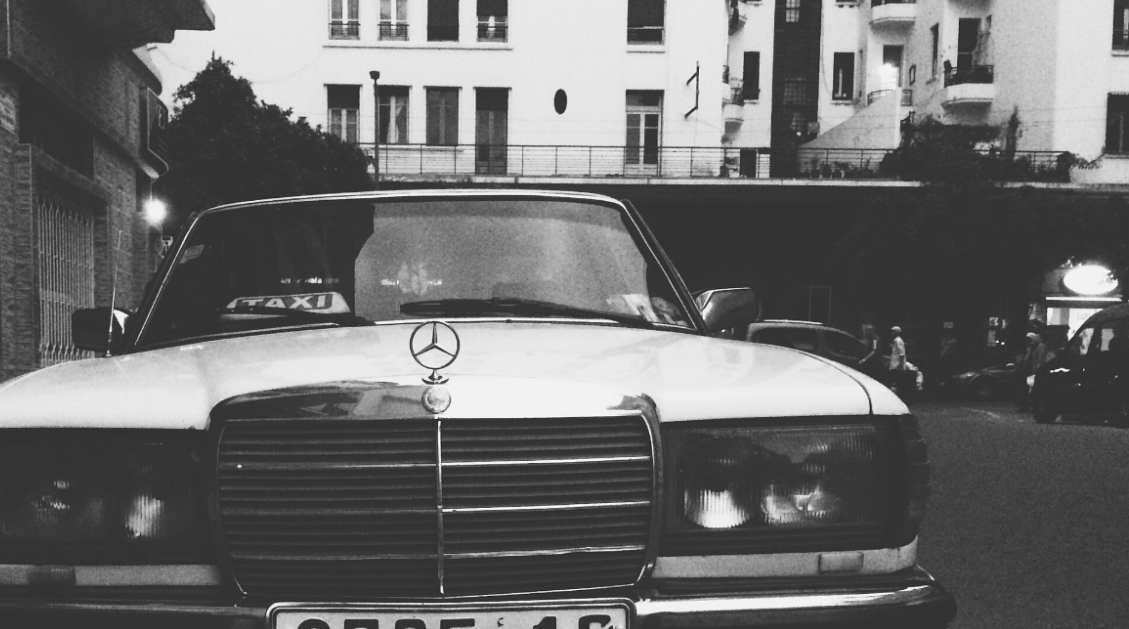
For decades, the Moroccan landscape was synonymous with the Mercedes-Benz W123, a vehicle affectionately known as the “Barrel.” This car is a cultural icon of North African endurance, celebrated for its “armoured” and “solid” reputation. The etymology of its local nickname, “Merci dix,” is a brilliant example of Moroccan French linguistic play. It is a pun on the local pronunciation of “Mercedes” and the phrase “thanks times ten” (merci dix). However, the Merci dix is reaching the end of its era. In 2014, the government launched a “scrap-and-replace” initiative to modernize the fleet. Drivers were offered subsidies, such as 10,000 MAD discounts, to transition from the vintage Mercedes to modern, air-conditioned 7-seat minivans like the Dacia Lodgy and Renault Trafic.
Source: Wikipedia

The Unwritten Rules of Morocco’s Shared Taxis
The Moroccan taxi experience is not like others. Drivers may actually refuse a ride if a destination deviates too far from their current route. Beyond the standard hand wave, passengers use a specific pointing method to indicate their direction, allowing the driver to judge if the route aligns with current passengers. Furthermore, the “incessant beeping” heard on Moroccan streets is rarely an expression of anger; it is an offer of a lift from a driver to a pedestrian. Drivers frequently pull over to pick up multiple independent passengers heading in the same direction. Each party pays their own metered or fixed fare independently. Should a dispute or blatant overcharging occur, the passenger holds a powerful “social safety valve” : the threat of calling the “Tourist Brigade” (Brigade Touristique), a specialized police unit that quickly resolves driver-passenger conflicts.