
Earlier this year well before the pandemic one of my last memorable trips in the Middle East was to Saudi Arabia to visit their Desert X Al Ula site specific installation. Read my post experiencing a sunset in Al Ula here.
Al Ula is Saudi Arabia’s first UNESCO World heritage site (since 2008) in the Northwest region of Saudi Arabia. The area is located at the crossroads of ancient civilizations on the Arabian Peninsula that had been very much unexplored until now. Found within one of the harshest environments, the modern agricultural town of Al Ula (pop. 6,000) is relieved by Wadi al-Qura (Valley of Villages), an abundant aquifer-fed oasis.
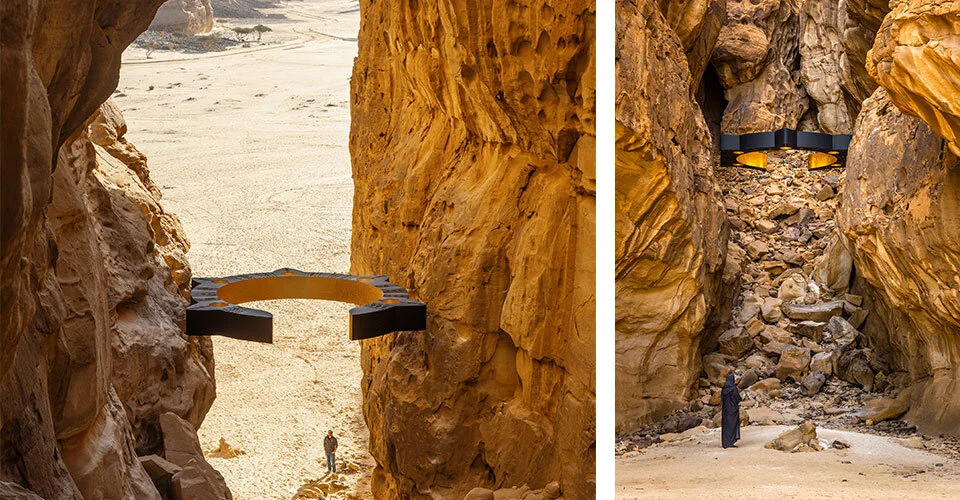
Arriving in Al Ula, with my map in hand on an adventure to explore the works speckled across the site, my first work was Sherin Guirguis’ larger-than-life-sized anklet wedged in between a gorge. Inspired by the Bedouin jewelry piece given to the artist by her mother, the artist then scaled it within the vast desert landscape. Suspended, floating in mid-air, the anklet contains a golden interior inscribed by a Bedouin poet.
The Egyptian born, Los Angeles based artist
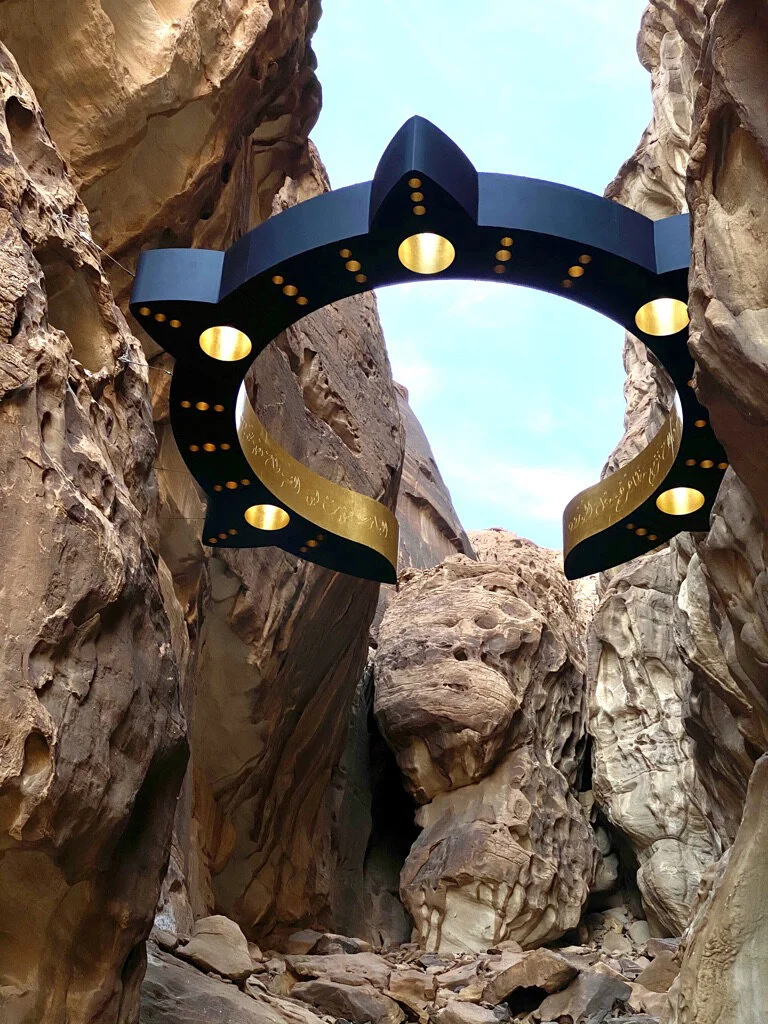
Sherin Guirguis, “Kholkhal Aliaa,” 2020. 18ft diameter. Powder coated Aluminum, 24K Gold leaf.
MEA: This is your second time participating in Desert X for you --the first in the Desert X Biennial in 2017 in Palm Springs and now in Al Ula. How was each experience different and similar? Was the desert land overall similar in environments, or completely different?
SG: I found them to be very different. Each of these deserts is very unique, not only in its geology but also and most importantly the history and cultural context. That of course is what drives the work.
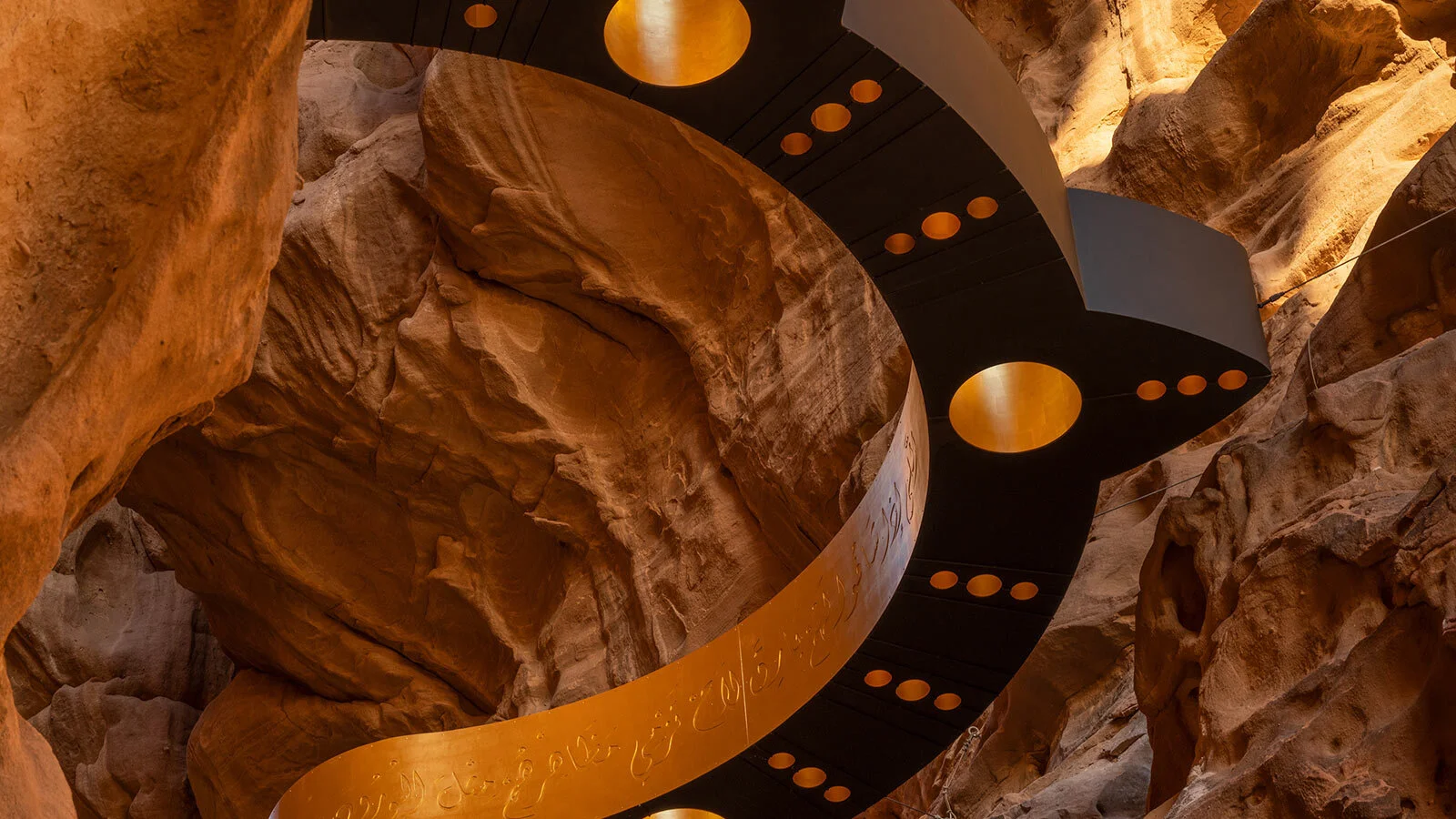
Detail of “Kholkhal Aliaa,” 2020.
MEA: How did you find the exact space in between a grotto - how did you know this would be the perfect place for your work?
SG: During the site visit we walked the valley together. I was looking for a site that was somewhat hidden, one that would require the viewers to walk and discover the piece as they wondered the site. As I walked through the valley I came to the gorge and it was shaded and sheltered. The geology is incredibly striking and it felt that the mountain was wrapped around you as you looked right down the mouth of the valley. I knew immediately that this was the site for my work.
MEA: How did you produce the work? Technical process.
SG: I had a kholkhal that was given to me by my mother. I loved this beautiful piece and always wondered about it’s history. I created this work inspired by my moms kholkhal. My team and i produced drawings and digital files that were then produced by a fabrication team in Portland Oregon.
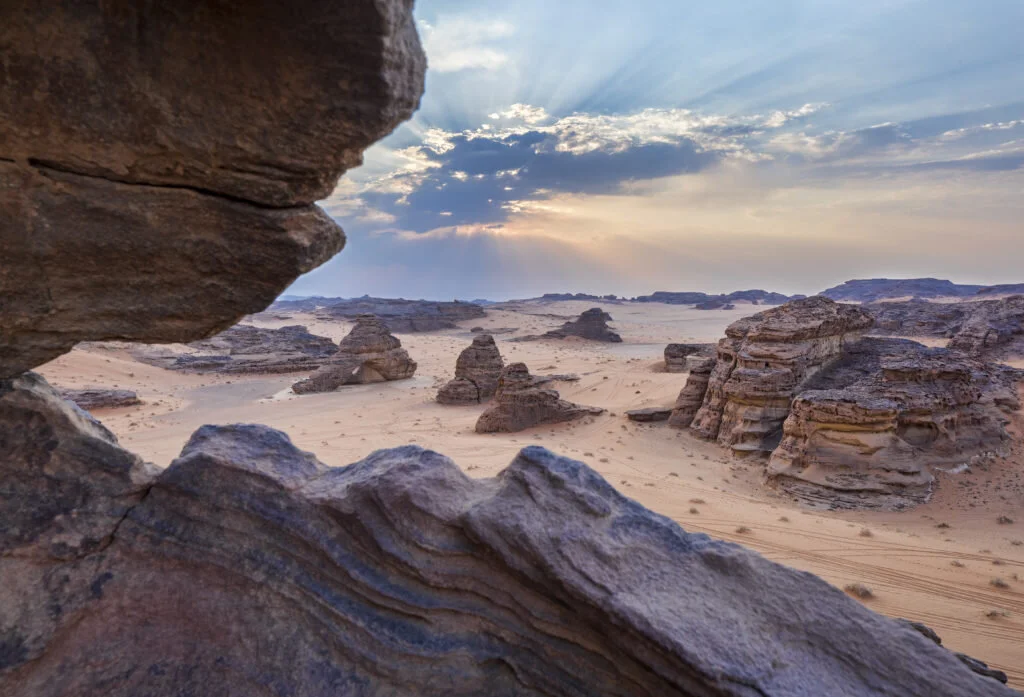
Al-Ula, the site of the forthcoming Saudi edition of Desert X. Image courtesy of the Royal Commission for Al-Ula.
MEA: What was the hardest part of producing the work?
SG: Some of the most challenging aspects of this projects arose due to the time constraints and remote location. Ideally for a large-scale, site specific sculpture I would be able to spend a lot of time at the site and test out models and samples, however due to the remote location hat was very challenging. So much of the engineering and design had to be flexible to facilitate the installation.
MEA: What is the particular ornamentation of the 'Kholkhal Aliaa'? Is it a complete replica of the exact bracelet given to you by your mother, or you played with the form slightly, coloring, etc. What is the writing inscribed in gold ?
SG: No, the sculpture is inspired by the kholkhal but it is not a replica. I simplified the form to achieve a work that hovers between a minimalist sculpture and a exuberant monument. I also added the text from Aliaa’s poem.
MEA: What was your first experience of traveling to Al Ula like? Your first memories there..?
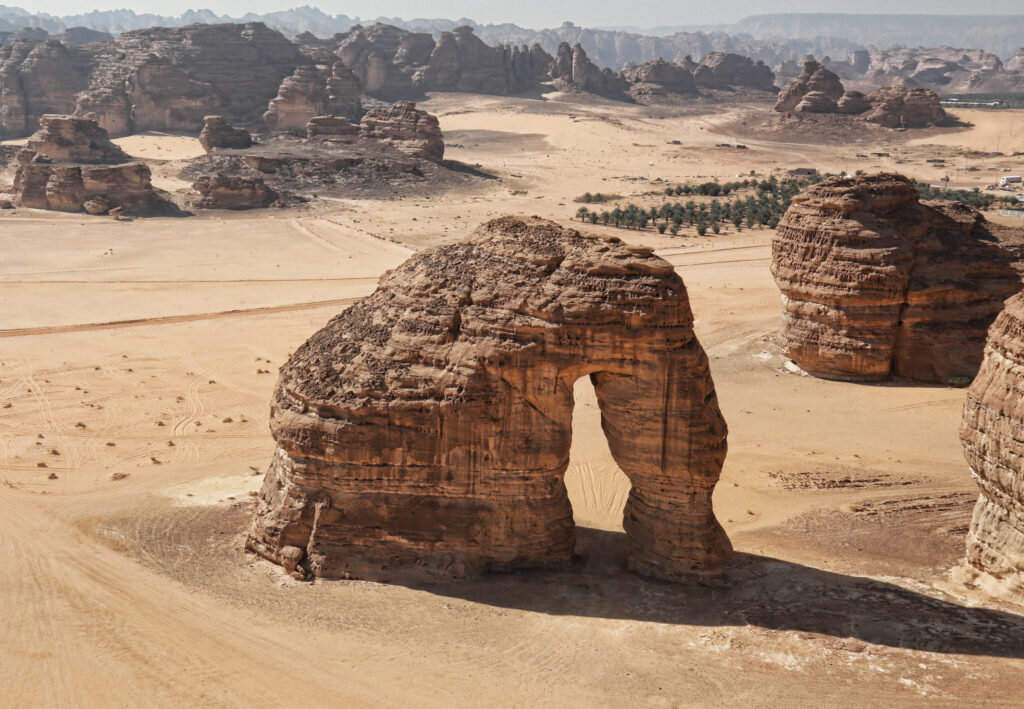
Elephant Rock, AlUla, image courtesy of RCU. Image courtesy of the Royal Commission for Al-Ula
SG: I travelled for my initial site visit and was struck by the Al Ula. It's beauty, scale, history and most of all its people . I knew I wanted to make a work that honored the history culture of Al Ula, and in particular, the women who have long sustained its traditions through art, craft and poetry. So I began my research and as usual found very little record of the cultural work of women from the past. I did come across a poem by Aliaa Al Otaibi that really really struck me. Her recollections of life in the desert were very moving and powerful.
The poem loosely translates to:
I stayed up late yesterday till the moon faded away
My eyes wide open while the tribes are asleep
My heart lies where I left my soul in the desert
I try to balance and live the legacy of my predecessors
Whom when they see lightning flashes
Like flowers, they rejoice and flourish
I decided that I wanted to echo her words in the new work as a way to honor the women of the region. I also had a chance to work with the local elder women and produce a sister piece of Sadou weaving that echoed the sculpture. That experience was transformative for me. I am in awe of these women’s talent and generosity and so grateful for have had a chance to work with them.
MEA: Do you enjoy producing site specific work - prefer producing painting or sculpture ?
SG: They are such different processes altho I cant choose. I love to do both types of work and they are fulfilling in different ways. The site specific works are always a challenge. I love learning about the site and responding to what’s already there. Entering in a conversation and exchange with a community I had not met before.. That is always an honor and a pleasure. The work I produce in the studio is responding to met own needs and concerns. It is grounded in my own research and questions about the history of women in the middle east. Not as tided into a specific site.
MEA: What was another work in Desert X Al Ula that particularly resonated with you?
SG: So many of these works resonated with me. I found that many of the works were in conversation with one another. it was a pleasure to experience so many different views and responses to the site.
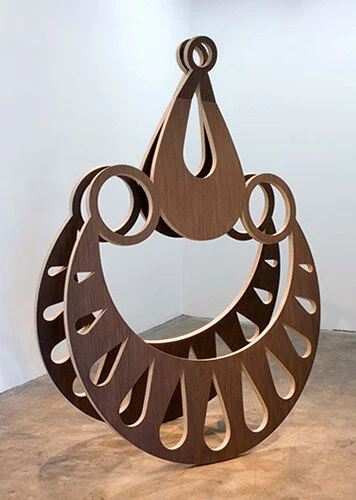
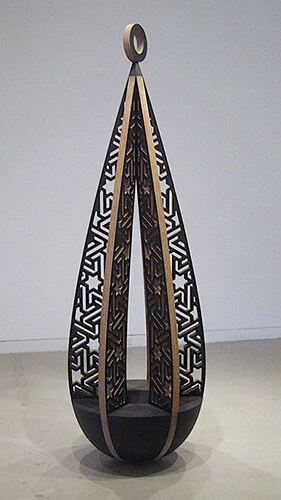
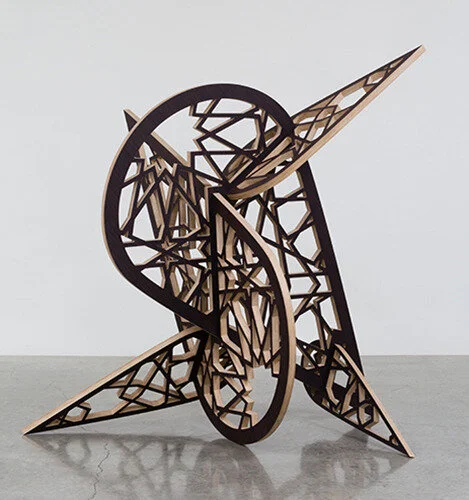
MEA: Did 'Kholha Aliaa' take inspiration from your Cairo trilogy works? As they appear similar in form and concept?
SG: They are similar in that the methodology is parallel. Taking an everyday, ornamental object and using it as a vehicle to discuss the power of women in history.