
by Muhammad Yusuf, Features Writer. “Mid East Art, the art platform founded and run by Dubai-based Suzy Sikorski that acts as both an art historical archive and periodical featuring a comprehensive coverage of interviews and exhibition reviews of artists from the Middle East, has announced that it will partner with the UAE Embassy’s Cultural Diplomacy Department in Washington DC on a series of digital programming.”
Read moreAn Interview with Sherin Guirguis: Desert X Al Ula
Earlier this year well before the pandemic one of my last memorable trips in the Middle East was to Saudi Arabia to visit their Desert X Al Ula site specific installation. Read my post experiencing a sunset in Al Ula here.
Al Ula is Saudi Arabia’s first UNESCO World heritage site (since 2008) in the Northwest region of Saudi Arabia. The area is located at the crossroads of ancient civilizations on the Arabian Peninsula that had been very much unexplored until now. Found within one of the harshest environments, the modern agricultural town of Al Ula (pop. 6,000) is relieved by Wadi al-Qura (Valley of Villages), an abundant aquifer-fed oasis.
Arriving in Al Ula, with my map in hand on an adventure to explore the works speckled across the site, my first work was Sherin Guirguis’ larger-than-life-sized anklet wedged in between a gorge. Inspired by the Bedouin jewelry piece given to the artist by her mother, the artist then scaled it within the vast desert landscape. Suspended, floating in mid-air, the anklet contains a golden interior inscribed by a Bedouin poet.
The Egyptian born, Los Angeles based artist
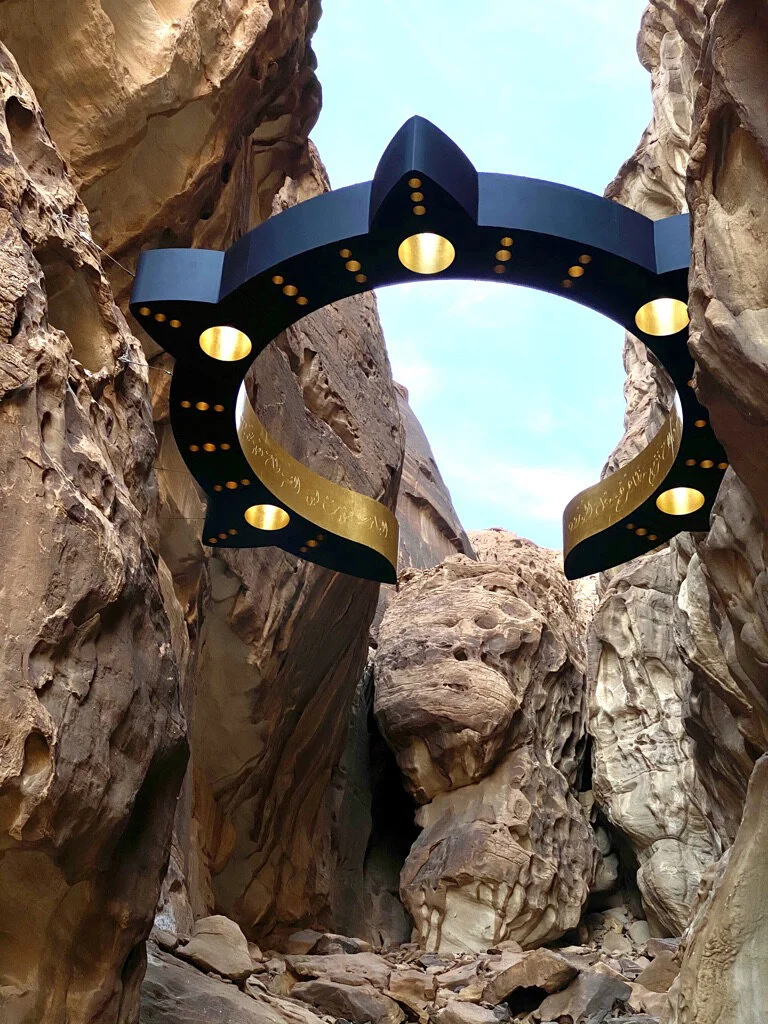
Sherin Guirguis, “Kholkhal Aliaa,” 2020. 18ft diameter. Powder coated Aluminum, 24K Gold leaf.
MEA: This is your second time participating in Desert X for you --the first in the Desert X Biennial in 2017 in Palm Springs and now in Al Ula. How was each experience different and similar? Was the desert land overall similar in environments, or completely different?
SG: I found them to be very different. Each of these deserts is very unique, not only in its geology but also and most importantly the history and cultural context. That of course is what drives the work.
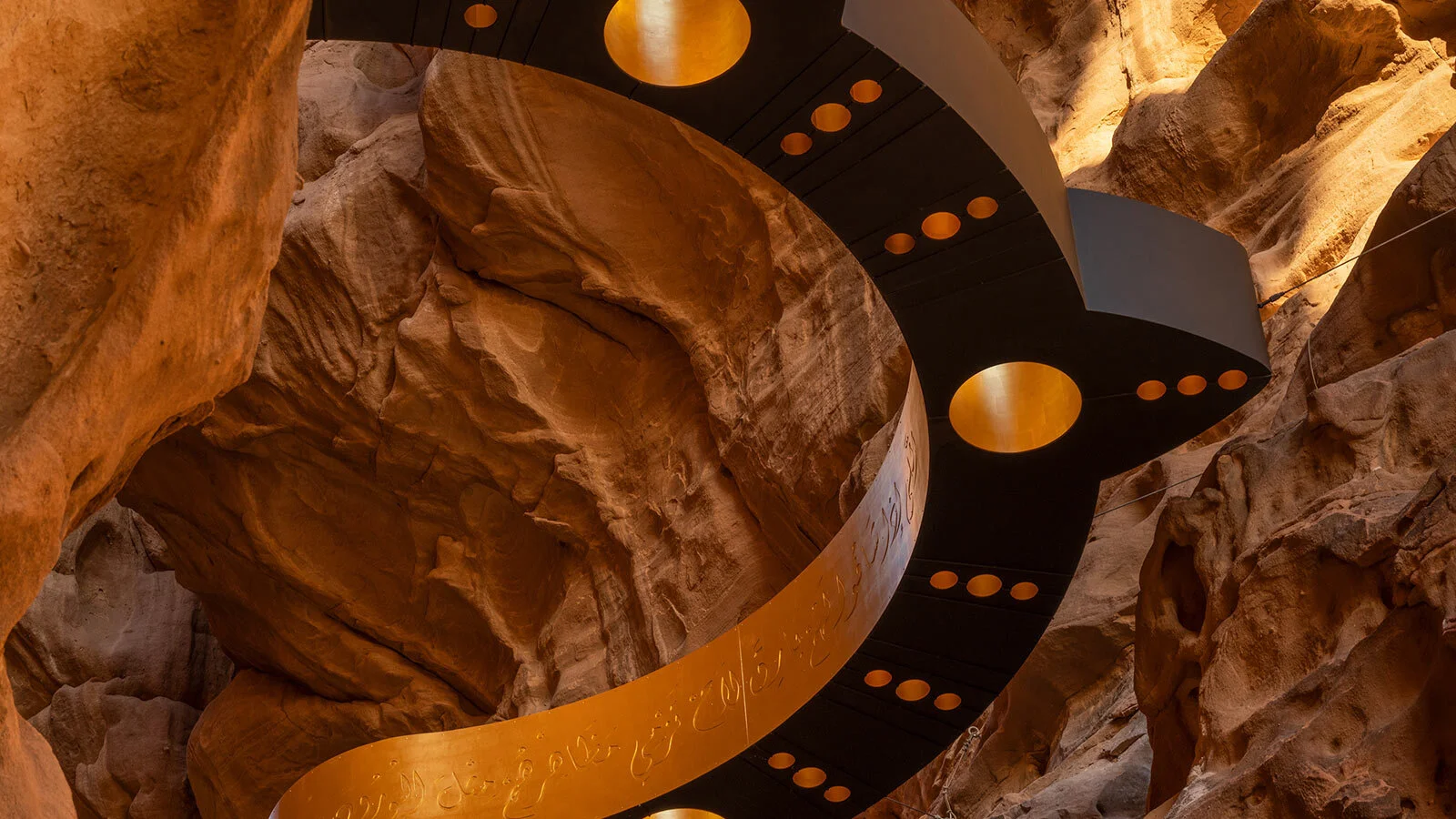
Detail of “Kholkhal Aliaa,” 2020.
MEA: How did you find the exact space in between a grotto - how did you know this would be the perfect place for your work?
SG: During the site visit we walked the valley together. I was looking for a site that was somewhat hidden, one that would require the viewers to walk and discover the piece as they wondered the site. As I walked through the valley I came to the gorge and it was shaded and sheltered. The geology is incredibly striking and it felt that the mountain was wrapped around you as you looked right down the mouth of the valley. I knew immediately that this was the site for my work.
MEA: How did you produce the work? Technical process.
SG: I had a kholkhal that was given to me by my mother. I loved this beautiful piece and always wondered about it’s history. I created this work inspired by my moms kholkhal. My team and i produced drawings and digital files that were then produced by a fabrication team in Portland Oregon.
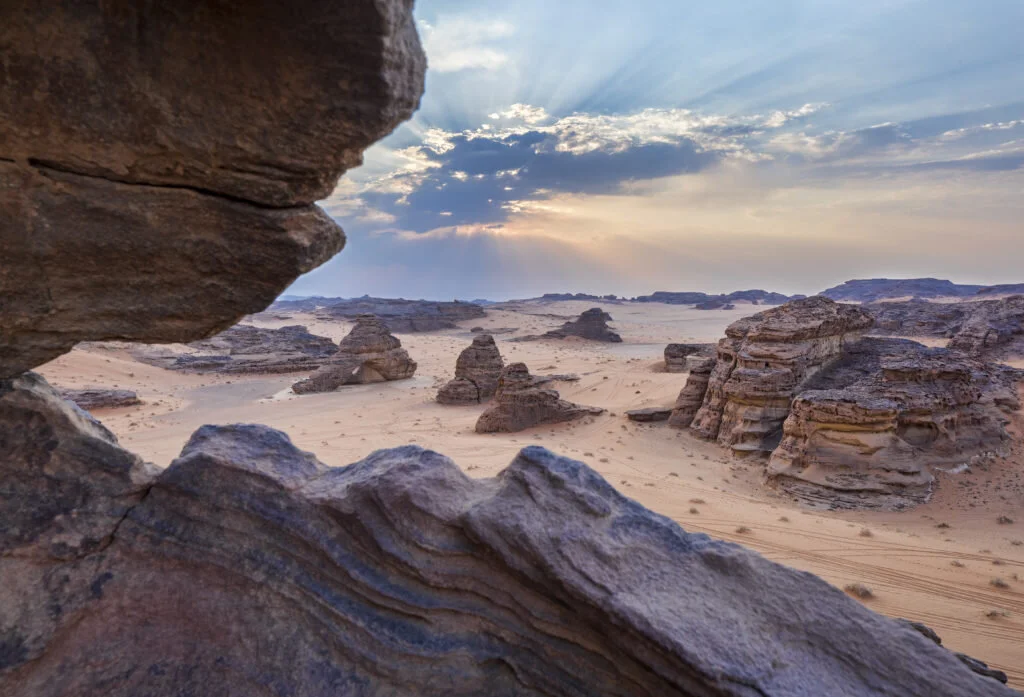
Al-Ula, the site of the forthcoming Saudi edition of Desert X. Image courtesy of the Royal Commission for Al-Ula.
MEA: What was the hardest part of producing the work?
SG: Some of the most challenging aspects of this projects arose due to the time constraints and remote location. Ideally for a large-scale, site specific sculpture I would be able to spend a lot of time at the site and test out models and samples, however due to the remote location hat was very challenging. So much of the engineering and design had to be flexible to facilitate the installation.
MEA: What is the particular ornamentation of the 'Kholkhal Aliaa'? Is it a complete replica of the exact bracelet given to you by your mother, or you played with the form slightly, coloring, etc. What is the writing inscribed in gold ?
SG: No, the sculpture is inspired by the kholkhal but it is not a replica. I simplified the form to achieve a work that hovers between a minimalist sculpture and a exuberant monument. I also added the text from Aliaa’s poem.
MEA: What was your first experience of traveling to Al Ula like? Your first memories there..?
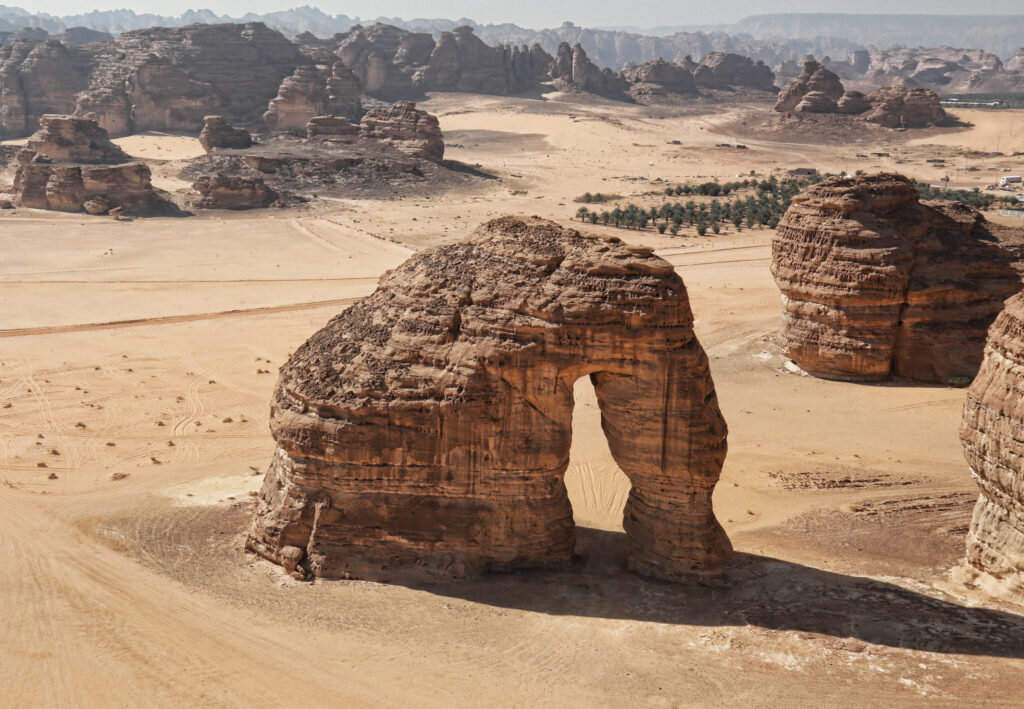
Elephant Rock, AlUla, image courtesy of RCU. Image courtesy of the Royal Commission for Al-Ula
SG: I travelled for my initial site visit and was struck by the Al Ula. It's beauty, scale, history and most of all its people . I knew I wanted to make a work that honored the history culture of Al Ula, and in particular, the women who have long sustained its traditions through art, craft and poetry. So I began my research and as usual found very little record of the cultural work of women from the past. I did come across a poem by Aliaa Al Otaibi that really really struck me. Her recollections of life in the desert were very moving and powerful.
The poem loosely translates to:
I stayed up late yesterday till the moon faded away
My eyes wide open while the tribes are asleep
My heart lies where I left my soul in the desert
I try to balance and live the legacy of my predecessors
Whom when they see lightning flashes
Like flowers, they rejoice and flourish
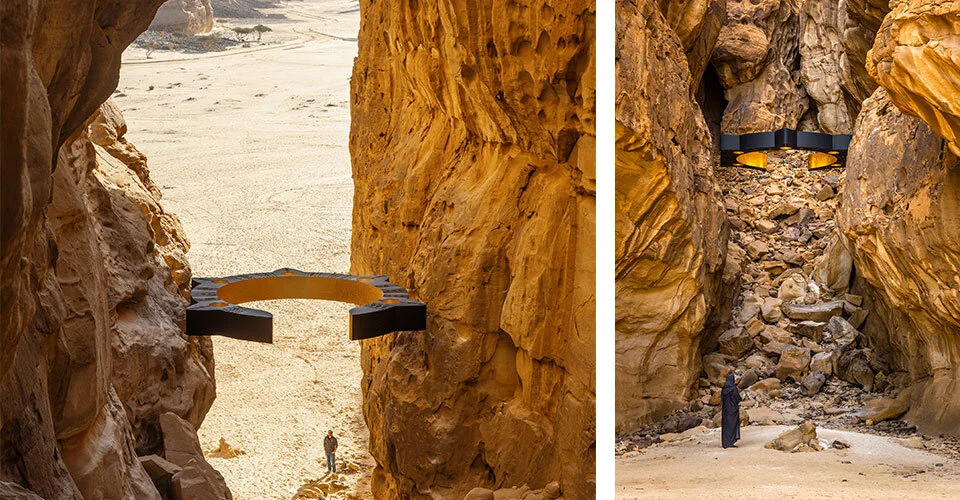
I decided that I wanted to echo her words in the new work as a way to honor the women of the region. I also had a chance to work with the local elder women and produce a sister piece of Sadou weaving that echoed the sculpture. That experience was transformative for me. I am in awe of these women’s talent and generosity and so grateful for have had a chance to work with them.
MEA: Do you enjoy producing site specific work - prefer producing painting or sculpture ?
SG: They are such different processes altho I cant choose. I love to do both types of work and they are fulfilling in different ways. The site specific works are always a challenge. I love learning about the site and responding to what’s already there. Entering in a conversation and exchange with a community I had not met before.. That is always an honor and a pleasure. The work I produce in the studio is responding to met own needs and concerns. It is grounded in my own research and questions about the history of women in the middle east. Not as tided into a specific site.
MEA: What was another work in Desert X Al Ula that particularly resonated with you?
SG: So many of these works resonated with me. I found that many of the works were in conversation with one another. it was a pleasure to experience so many different views and responses to the site.
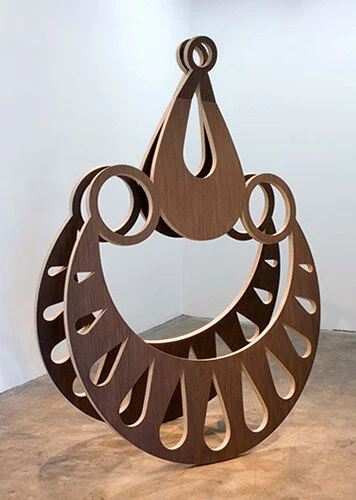
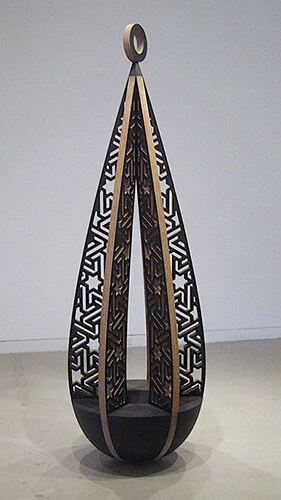
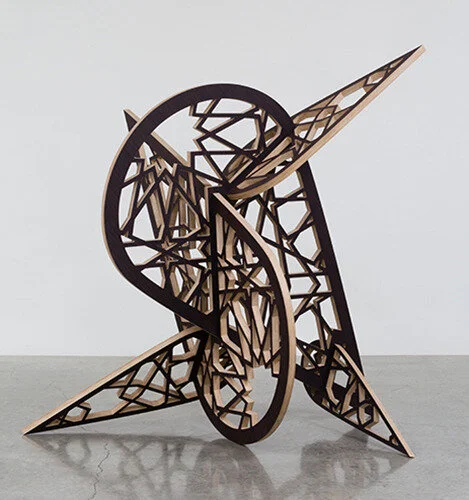
MEA: Did 'Kholha Aliaa' take inspiration from your Cairo trilogy works? As they appear similar in form and concept?
SG: They are similar in that the methodology is parallel. Taking an everyday, ornamental object and using it as a vehicle to discuss the power of women in history.
Jumping and Swinging back into Hassan Sharif's 1980s Performances: An Interview with Mohamed Sharif, the Artist's Nephew
Jump into week 7 of the quarantine with Emirati artist Hassan Sharif in his early 1980s performances in Dubai and London! Finding a few parallels to our methodical and rather mundane day-to-days in self-isolation, we are reminded of Hassan’s carefully constructed activities rooted in Fluxus and British Constructivist thought. We sit down (virtually) with his nephew Mohamed Sharif to discuss the role of performance in his uncle’s practice and Mohamed’s archival work at the Artist’s Estate.
Read morePresenting 'Artists in Quarantine' : Finding Creativity in Self-Isolation


Introducing the ‘Artists in Quarantine’ series that is documenting artists from the region who are finding creativity in self-isolating times. What are artists doing while under quarantine in their studio and creative spaces? The series featured in short episodes on Instagram and MEA blog includes photos, short videos and inspiring quotes—opening a window into these artists’ intimate spaces to see how they have been creatively coping.
Read moreSomewhere 'Betwixt and In-Between' - An Interview with Munira Al Sayegh
While unraveling time-warped thoughts one month into the quarantine, Suzy interviews Munira Al Sayegh on her experience curating ‘Bayn’ with UAE Unlimited in 2017. Reflecting on this shared ‘in-between-ness’ sensation, their conversation trails from their personal lives growing up in Abu Dhabi and New York and Munira’s takeaway moments of her first-ever curated show.
Read moreHope is Contagious in Prison: Inji Efflatoun in Isolation between 1959-1963, Egypt
‘The Quarantine Files’ series presents of the most inspiring stories of the pioneer Egyptian female artist Inji Efflatoun during her time as a political prisoner in jail from 1959-1963. Including first hand accounts from Inji herself, this article is a story of how bravery, perseverance and ingenuity lead to self-discovery and artistic explorations —all while confined and quarantined within a jail cell. Hope is just as contagious these days - read on.
Read moreSuzy Speaking on Sultan Al Qassemi's Online Cultural Majlis

Image courtesy of The National newspaper, UAE.
This April, Suzy shared her ‘story on Instagram storytelling’ in promoting further Middle Eastern art education during Sultan Al Qassemi’s first online cultural majlis. Speakers included HE Noura Al Kaabi, Minister of Culture and Knowledge Development; Vilma Jurkute, Director of Alserkal Avenue; Manal Ataya, Director-General of the Sharjah Museums Authority; Suheyla Takesh, Curator at Barjeel Art Foundation; and Bill Bragin, Executive artistic director of The Arts Center at NYU Abu Dhabi.
Read moreTime Warped Thoughts in Isolation - Week 10
Excerpt of my Intro to April 2020 Newsletter
Read moreExploring our 'In-between-ness' in an interview with Fatima Albudoor on her Artist Book: 'Making Cathedrals'
In this interview, uncover the stories of Emirati photography Fatima Albudoor on adapting to college life in Boston as illustrated beautifully and intimately in her artist book ‘Making Cathedrals.’ Exploring the sensations of transience, dislocation and the ‘in-between-ness’ of our life journeys, this emotional read is a must during our quarantine days ahead.
Read moreCelebrating 3 Years of Mid East Art

Suzy Sikorski in Al Madam, Sharjah. Taken by Fatima Albudoor.
Mid East Art founder Suzy Sikorski reflects on her unforgettable memories documenting artist’s stories in the region since embarking on a Fulbright Scholarship in 2016. With insights behind her drive to archive a close-knit community of Emirati artists, along with her recent photography skills and visual anecdotes that encompass her lifelong journey to cover Middle Eastern Art.
Read moreVisual Anecdotes of an Archiver
The vivid narratives of Suzy Sikorski’s lengthy photography adventures and artist studio sessions. Both a witness and active player in these memories, Suzy weaves her way into these beautifully captured stills.
Read moreOut of Focus - An Interview with the Emirati Photographer Ammar Al Attar
Digging into the 2017 archives of the first time I interviewed Ammar Al Attar, we trace the Emirati photographer’s evolution of his four-year-long archival Cinema in the UAE Project. How do we remember what’s lost and give importance to the unwanted and overlooked? Read on!
Read moreImago Mundi: Amid Desert and Future --Contemporary Artists from the UAE and Bahrain
Featuring an intro text by Suzy Sikorski on the origins of the UAE art scene that was included in the Imago Mundi Project she co-curated for the UAE and Bahrain in 2016.
Read moreUncovering the Signs of Invisibility - The Photography of Ahlam Shibli
An essay on the Palestinian photographer Ahlam Shibli in Tribe Photography magazine. Shibli’s hyper-visual images draw deeper attention to everyday life, and shift our understanding of marginalized communities as they are depicted in media images, closing the distance between documentary and spontaneous intimacy, and between critical detachment and compassionate engagement.
Read moreAli Cha'aban: An Interview Uncovering the Layers of his Work
Ali Cha’aban in front of “The Broken Dream”, silkscreen on Persian carpet, 2016. Image courtesy of the artist.
Meet Ali Cha’aban, a Lebanese born, Jeddah based artist who is tackling what it means to be Arab in today’s world. His works are triggering new debates relevant to global politics and social realities, explored through his interactive installations, street and fashion photography. Mid East Art sits down with the artist to discuss his unique inspirations and where he's going.
Read moreAmerican University of Sharjah: From New York to Dubai: Suzy Sikorski's Journey
The International Exchange Office at the American University of Sharjah interviews Suzy on her early inspirations to study art in the Middle East and her junior year studying at AUS in Fall 2014.
Read moreEmbracing the Virtual Display: An Interview with Bahraini artist Sheikh Rashid bin Khalifa
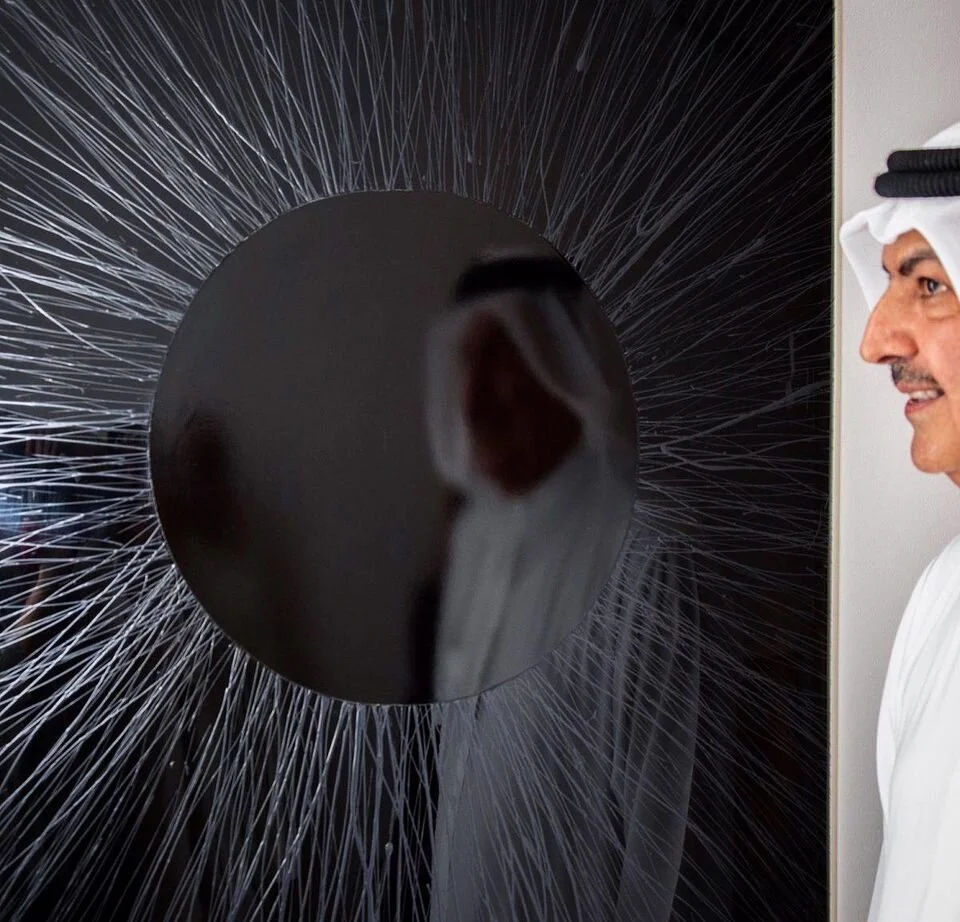
Sheikh Rashid Al Khalifa during the 2019 exhibition opening "In Parallel" at Bait Muzna Gallery in Muscat, Oman
How does virtual viewing galleries enhance art appreciation? As part of Mid East Art’s ‘Art & Tech’ series, we interviewed Bahraini artist Sheikh Rashid bin Khalifa on his recent work in the quarantine and his early embrace of virtual art display on Google Arts & Culture.
Read moreLatif Al Ani: Through the Lens Father of Iraqi Photography
Latif Al Ani, whose role as ‘Father of Iraqi Photography’ encompasses three decades of documentation, from the 1950s through 1970s. His work captures the belle époque of the cosmopolitan and modern Iraq during these years.
Read moreFinding Clarity in Darkness - A Tribute to the late photographer Saleh Al Ustad
Mid East Art unveils never before seen footage and an interview text of the late Saleh Al Ustad, one of the pioneer fine art photographers of the UAE and Gulf region. This feature documents Saleh’s history from Missouri to Southern California in the early 1980s and the establishment of a fine art scene in the UAE.
Read more20 Women At The Top Of The UAE Art Scene

Suzy was ranked on the list as part of a group of women in the UAE who are championing the arts —from artists and curators to gallerists and the founders of collectives for young and emerging artists from the region.
Read more