
A Place Like No Other
Aisha Esmaeilzadeh
Hussain Ali Al Khawaldi arrived in the UAE from Syria more than forty years ago. Like many others who came searching for stability and opportunity, he slowly built a life for himself in Dubai through routine, patience, and consistency.
Over time, his small Arabic coffee stand on Naif Street became more than just a place to buy coffee. It became part of the rhythm of the neighborhood itself. For as long as people around the area can remember, Hussain Ali remained in the same spot near the Gold Souq.
The city around him changed constantly. Buildings rose, roads shifted, businesses disappeared and reopened under different names. Dubai continued moving forward at a speed few cities in the world can match. But somehow, his presence always felt permanent.
Every day, he prepared Arabic coffee the same way. He bought the coffee beans himself from the Old Souq, carefully grinding them before making each batch by hand. There was something deeply comforting about that routine. It was not only the coffee people returned for, but the familiarity of seeing him there — the same warm face, the same quiet energy, the same small stand waiting in its corner of Naif Street.
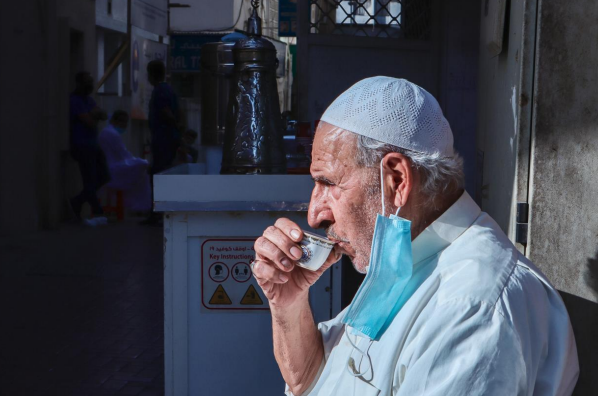
People from different backgrounds passed by him every day. Workers, shop owners, elderly men, teenagers, tourists, families, delivery drivers, strangers simply walking through the neighborhood. Some stopped for only a few minutes, while others stayed longer to exchange conversations.
Yet somehow, Hussain Ali treated everyone with the same warmth. In a city often described through skyscrapers and luxury, places like his carried a different side of Dubai — one built through human connection, repetition, and small everyday rituals. The kind of places that may look ordinary at first glance, but slowly become woven into people’s lives without them even realizing it.
That is what I think this photograph represents to me. Not simply a man drinking or serving coffee, but a feeling tied to a place and a period of time that now feels impossible to separate from the memory of Dubai itself.
I took this photograph during the COVID period, when masks had become part of everyday life. At the time, people were only allowed to remove their masks in public while eating or drinking. The city felt quieter then. Distances existed between people in ways we were not used to before.
Yet even during those uncertain months, many still continued visiting Hussain Ali’s coffee stand.
Maybe because comfort becomes even more important during difficult times.
There was something reassuring about seeing familiar places remain open when the rest of the world felt unstable. Even a small cup of Arabic coffee could momentarily make life feel normal again. People would stop by his stand not only out of habit, but because some routines quietly help us hold ourselves together.
Looking back now, I realize that some of the most meaningful places in a city are not necessarily the famous ones. They are the places connected to memory. The places where people gathered without planning to create memories at all.
A small coffee stand on Naif Street.
The smell of freshly ground coffee.
The sound of conversations drifting through the alleyways.
The familiar sight of Hussain Ali sitting in the same spot year after year.
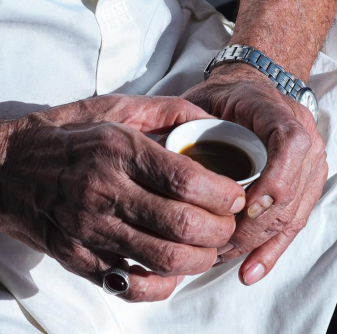
These details may seem small to others, but together they formed a piece of Dubai that felt deeply human.
In many Middle Eastern cultures, coffee itself carries meanings beyond the drink. It represents hospitality, conversation, generosity, and presence. Offering someone coffee is often an invitation into a shared moment, no matter how brief. Hussain Ali seemed to understand this naturally. His kindness stayed with people just as much as the coffee itself.
That is why I wrote that his Arabic coffee felt like “a place like no other.” Not because of luxury or rarity, but because certain people create an atmosphere that cannot truly be recreated anywhere else. Some individuals become emotionally attached to the spaces they occupy. Their presence transforms ordinary corners of a city into something memorable.
And often, we only fully understand their importance after they are gone. Hussain Ali passed away in September 2023. But for many people, his memory still feels alive within that street, within the routines he repeated for decades, and within the people who continue carrying those memories with them.
When I look at this photograph now, I notice more than the image itself. I notice time. I notice the quiet dignity of routine. I notice how deeply people can become connected to places through repeated everyday encounters. Most of all, I notice how fragile these moments really are.
Cities continue changing endlessly. Streets transform. Familiar faces disappear. Small businesses close. Entire eras quietly fade away while life keeps moving forward around them.
Photography cannot stop that change.
But perhaps it can preserve fragments of what once existed before they disappear completely.
This photograph became that for me: not simply a portrait of a man, but a memory of a feeling, a neighborhood, a ritual, and a part of Dubai that lives most strongly in the people who experienced it.
Sometimes the soul of a city is not found in its landmarks.
Sometimes it lives quietly inside a small cup of Arabic coffee shared on an ordinary street.